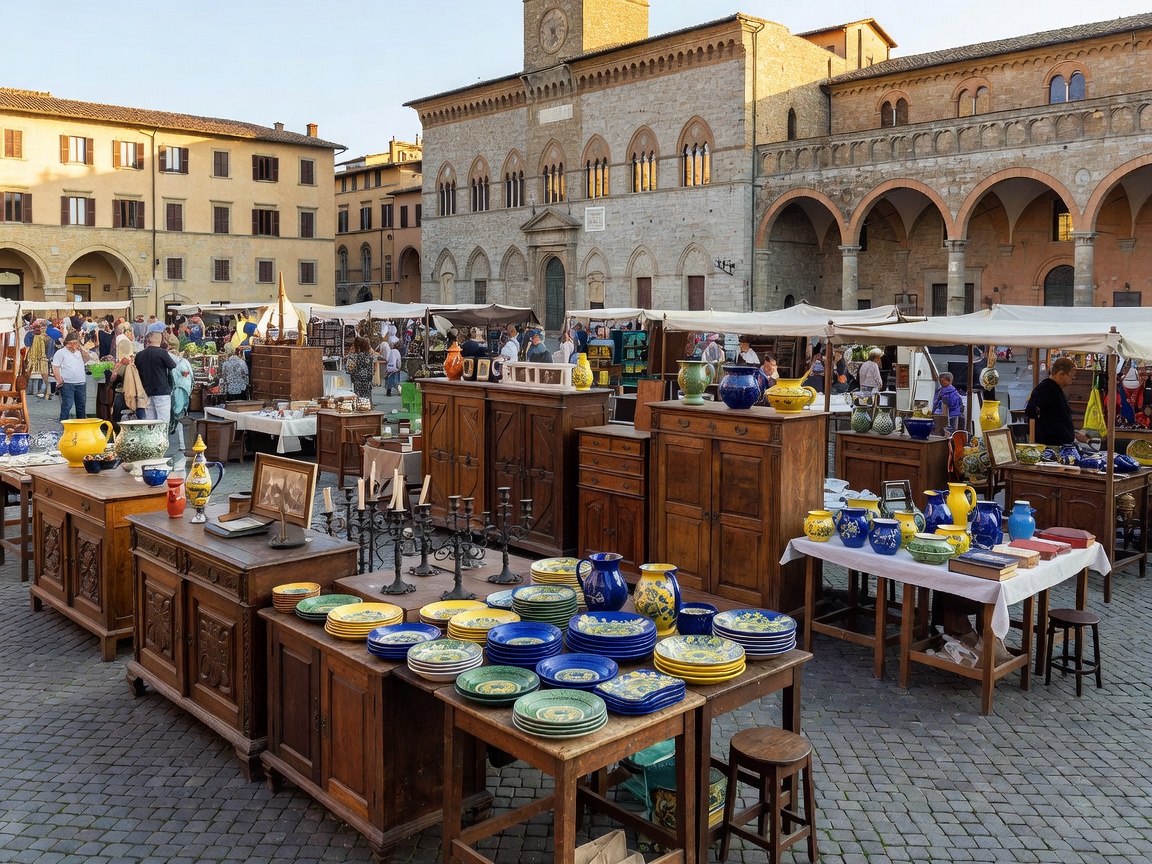
On the first Sunday of every month (and the Saturday immediately preceding it), the hilltop Tuscan city of Arezzo transforms. More than 500 vetted antique merchants, collectors, gallerists, and restorers occupy the Vasari Loggia, the cathedral steps, and the medieval alleys of the historic core.
1. The Geometry of the Market
The fair is strategically zoned by historical specialization:
Piazza Grande (The Vasari Loggia): High-end XVI–XVIII century Tuscan walnut furniture, monolithic refectory tables, polychrome wood church angels, and museum-grade Deruta majolica chargers.
Prato di Arezzo (The Hilltop Park): Country estate rustic furniture, copper caldrons, 19th-century farm tools, terracotta olive oil jars (orci), and vintage wrought iron garden pergolas.
Corso Italia & Medieval Alleys: Vintage watches, silver Grand Tour souvenirs, estate jewelry, Florentine leather boxes, and mid-century art glass.
"The light hitting the Vasari loggia at 08:00 AM reveals the true beeswax patina of 400-year-old Tuscan walnut. You cannot fake that glow." — Marco De Luca, Arezzo Guild Conservator
2. Etiquette & The Art of the Trattativa
Bargaining at Arezzo is not a confrontational transaction; it is a respectful Italian dialogue known as the trattativa:
• Always greet the antiquarian with a courteous "Buongiorno" before touching any object.
• Inquire about the object's provenance: "Qual è la provenienza di questo pezzo?"
• A customary 10% to 15% discount for cash payment is standard etiquette, but deeper discounts are earned through genuine appreciation of the craftsmanship.
3. International Logistics & Shipping from Tuscany
Acquiring a massive 3-meter walnut dining table in Arezzo is simple with proper logistics. The fair organizes official forwarding desks near Piazza del Duomo with insured white-glove crate shipping to North America, the UK, and Northern Europe, complete with Italian Export Ministry permits (Soprintendenza Archeologia, Belle Arti e Paesaggio).